
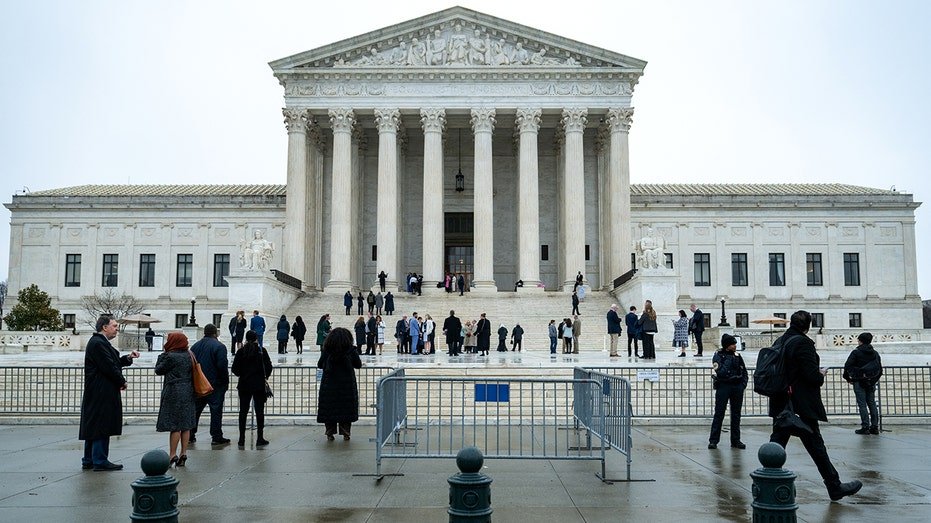
The Supreme Court handed down a victory for the Republican Party on Monday, striking down a lower court’s ruling that had blocked Texas’ plans for redrawing its congressional districts.
The court hung its order on reasoning from a previous ruling in Abbott v. League of United Latin American Citizens but did not elaborate. The three liberal justices, Sonia Sotomayor, Elena Kagan and Ketanji Brown Jackson, dissented.
The decision comes after the Supreme Court temporarily greenlit the state’s map in December and California’s map in February. Both states spearheaded the mid-cycle redistricting fights that have now been cropping up across the country. The high court’s approval of both states’ maps, giving Republicans and Democrats five-seat advantages, respectively, served to cancel each other’s efforts out ahead of the 2026 midterms.
DOJ BACKS TEXAS IN SUPREME COURT FIGHT OVER REPUBLICAN-DRAWN MAP
Texas Gov. Greg Abbott, a Republican, had asked the Supreme Court last year to pause a three-judge panel’s ruling in the Western District of Texas that found 2-1 that race was too much of a factor in its redraw and that the state had improperly attempted to pack Latino and Black voters into new districts.
The Department of Justice also chimed in, telling the high court to intervene and reverse the lower court decision, saying Texas’ choice to change its map was driven by purely “partisan objectives,” not racial objectives, which could violate the Voting Rights Act.
The voting and immigrant rights groups who challenged Texas and Abbott claimed that the map was an illegal racial gerrymander. The high court granted a 6-3 temporary stay in December, finding in an unsigned order that the groups had committed “at least two serious errors,” including that they did not extend the Texas legislature the “presumption of legislative good faith.”
REAGAN-APPOINTED JUDGE TORCHES COLLEAGUES IN TEXAS MAP FIGHT
Second, the groups did not offer an alternative map that served Texas’ stated political needs.
The high court said in the order that the lower court should also not have “interfered with an active primary campaign, causing much confusion and upsetting the delicate federal-state balance in elections.”
This is a developing story. Check back soon for updates.