
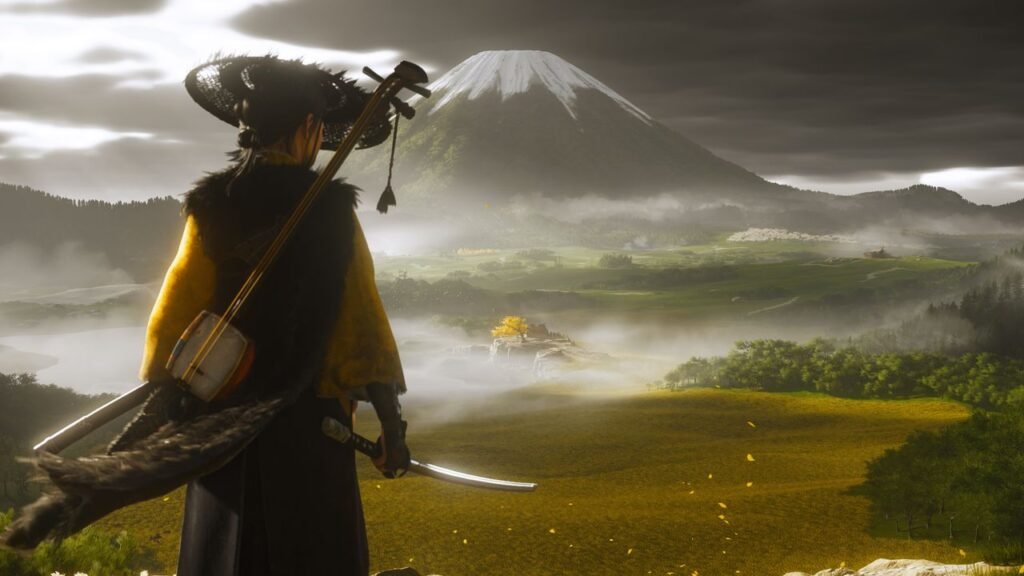
You’d be forgiven for believing last year’s Ghost of Yotei was materially larger than its predecessor Ghost of Tsushima. Multiple regions within the map and such a vivid recreation of Ezo contribute to Sucker Punch’s sequel seeming considerably bigger, but it’s all tricks of perception, as explained by art director Joanna Wang.
“Instead of asking how big it is, we started thinking about how big it should feel,” she reveals during a talk at GDC 2026 attended by GamesRadar+. “We’re not making a one-to-one copy, we are building a fictional version of Ezo. So we studied the island shape, mountains, coastline, ocean, and the horizon. We use a lot of them as the backdrop to help sell the scale.”
Amid the portions that make up the complete map, there are more linear paths that link them up, helping to gently trick players into believing this sandbox is a grand step up from the original than it is. “We divide the playable area to six regions, a massive open field, [and] narrow paths to connect each region together, [with] contrast between the openness and confinement,” she adds.
“In the end,” she continues, “the actual playable space wasn’t larger than Ghost of Tsushima, but it feels larger.”
It worked, because Ghost of Yotei takes the grand vibes of Tsushima and dials them up. Ezo offers so much to explore and poke through, especially if you’re totally unfamiliar with that part of Japan (or the country itself). But even if you do know the area, it’s a stunning recreation, as Final Fantasy 14’s Naoki Yoshida pointed out, since it reminded him of his own time holidaying in the region.
Controlling your perception is often more powerful than raw numbers, and Sucker Punch managed to go bigger without having to actually do so. The only problem now is, how does the studio create more of this magic for whatever comes next?