
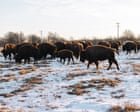
The Quapaw Nation is the only US Native community to carry out a cleanup of one of the country’s worst sites of environmental contamination
They call this land the Laue. In the late 1800s, part of these 200 acres of grassland inside the Quapaw Nation were allotted to tribal citizen Charley Quapaw Blackhawk. After forcing dozens of tribes into Indian territory before the civil war, the US government then parceled out reservations and property to individual members. It was part of the government’s attempt to “civilize” Native Americans by turning them into private, not communal, landholders and yeoman farmers in the model of Thomas Jefferson’s ideal citizen.
Yet, for the last century, little grew on the Laue. Half of it was buried beneath towering mounds of toxic rock known as chat piles. The waste rock, laced with chemicals, was left after miners extracted millions of tons of lead and zinc from the Tri-State Mining District, where the valuable ores stretched across Kansas, Missouri and Oklahoma between 1891 and the 1970s. By 1983, the Environmental Protection Agency (EPA) had designated 40 sq miles that include nearly all the Quapaw Nation as the Tar Creek Superfund site, joining the EPA’s list of the most contaminated places in the country. Informally called a “megasite”, Tar Creek remains one of the largest and most complex environmental disasters in the country.